Context
A limited sneaker drop can sell out in seconds, yet the damage from bots lasts far longer. Real customers leave frustrated, resale prices climb, support teams absorb the complaints, and the brand appears to have rewarded the fastest script rather than its most loyal fans. Effective sneaker bot prevention is not about blocking every unusual visitor. It is about seeing through automation that looks like a customer while preserving fair access for people who genuinely want to buy.
For sneaker and streetwear brands, scarcity is part of the product experience. That makes the purchase path a high-value target. Attackers do not need to compromise a site to cause commercial harm. They only need to reserve inventory, bypass queues, create accounts at scale, test checkout flows, or submit a coordinated burst of orders before real shoppers can act.
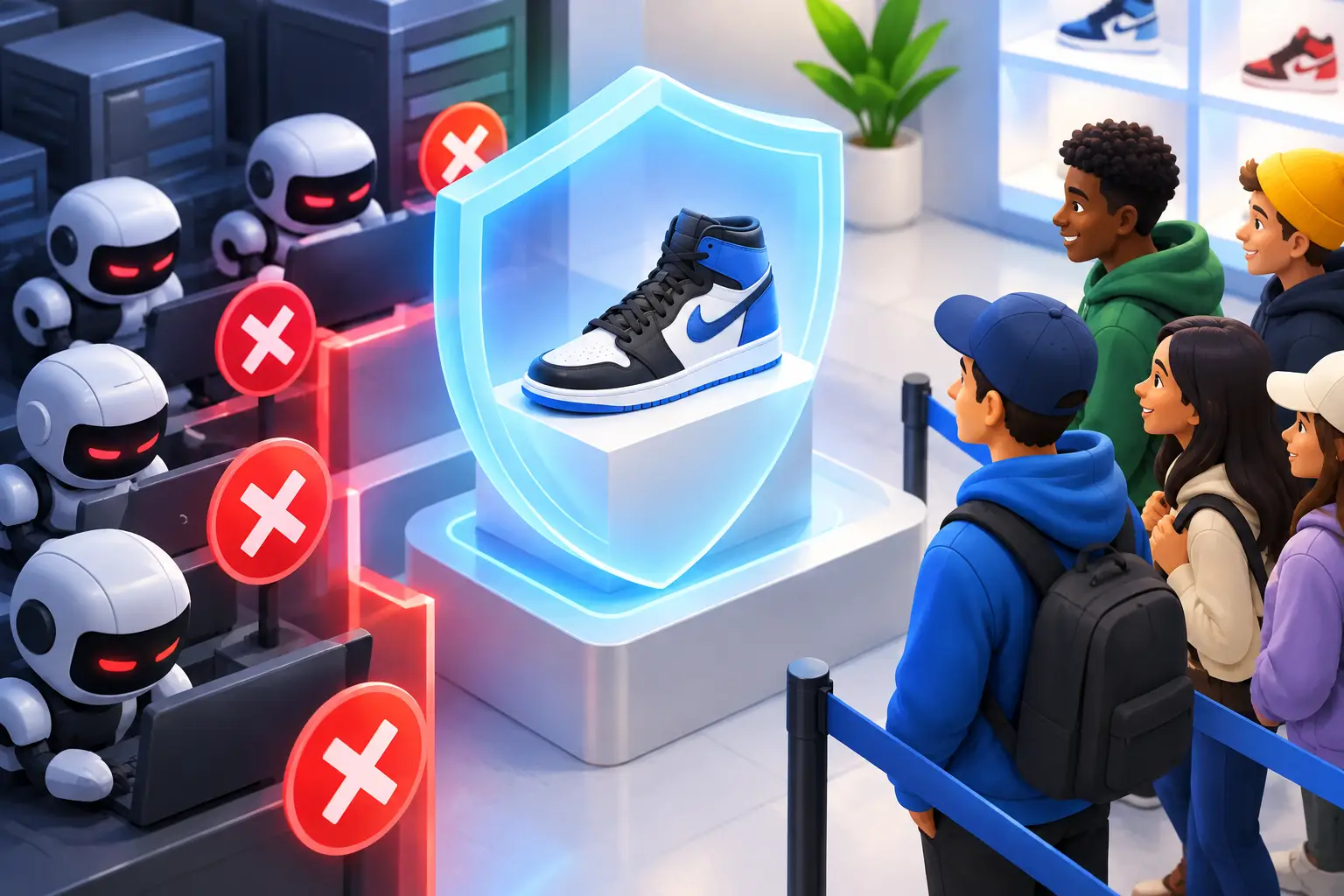
Why sneaker drops attract coordinated automation
A hyped release offers a clear incentive: limited inventory can be converted into resale profit within hours. Modern sneaker bots are built for that environment. They can monitor product changes, distribute traffic across large pools of devices and networks, solve or outsource challenges, manage multiple accounts, and automate checkout at a speed no customer can match.
The most damaging activity often begins before the drop. Attackers may create or age accounts, harvest product information, test payment methods, map APIs, and learn how a queue or release mechanism behaves. When inventory becomes available, the purchase attempt is only the final stage of a longer attack path.
This is why a single request rarely tells the full story. A clean-looking browser, a residential IP address, or a valid customer account can all be part of automated abuse. Conversely, a legitimate shopper may use a VPN, share a household device, refresh a page repeatedly, or buy from a mobile network with a changing IP address. Network category alone is not proof of fraud, and treating it as proof creates avoidable false positives.
Sneaker bot prevention starts with connected evidence
The strongest defenses assess intent across the interaction, not just whether one request appears suspicious. That means connecting evidence across browser, device, session, account, network, behavior, and request-level signals.
A useful decision model asks whether multiple signals point to a coordinated pattern. For example, a release may show the same device characteristics rotating through many accounts, a group of accounts following identical navigation paths, or checkout attempts arriving with timing that is too consistent to be human. Each signal by itself may be explainable. Together, they can expose an attack operation.
Four evidence categories are particularly valuable during a drop:
- Device and browser relationships: Reused device traits, automation artifacts, inconsistent browser behavior, and one device operating many identities can reveal account farms and scaled bot activity.
- Behavioral patterns: Human shoppers hesitate, browse, correct errors, and vary their timing. Automation often produces highly repeatable sequences, improbable speed, and synchronized actions across many sessions.
- Account and session history: Newly created accounts are not inherently malicious. But rapid account creation, shared device relationships, repeated failed releases, and coordinated account switching provide valuable context.
- Request and attack-path intelligence: Product polling, carting, queue entry, payment submission, and checkout retries should be viewed as a sequence. Attackers expose themselves through the path they take, not only at the final purchase request.
Connected evidence supports proportionate action. A low-confidence signal may justify observation or rate control. A high-confidence cluster tied to account creation, inventory reservation, and checkout automation may justify a block, challenge, or transaction hold. This layered approach gives attackers more work while asking less of real customers.
Protect the full drop lifecycle, not just checkout
Blocking bots at checkout is necessary, but it is often too late. By then, automated traffic may have already strained infrastructure, consumed queue capacity, reserved stock, or created thousands of accounts that will be reused on future releases.
Before the release: reduce attacker preparation
The pre-drop period is where brands can identify reconnaissance and build an operational baseline. Monitor unusual product-page polling, inventory endpoint activity, sudden account-creation spikes, and repeated attempts to learn release timing. Review whether attackers are concentrating on particular product IDs, geographies, browser configurations, or account flows.
Controls at this stage should focus on slowing abusive preparation without making ordinary browsing painful. Adaptive rate limits, protection for sensitive APIs, and policies for anomalous account creation can reduce the inventory of accounts and sessions available to attackers when the release begins.
During the release: defend scarce actions first
Not every page deserves the same protection. Product discovery can tolerate more traffic than queue entry, cart reservation, account login, payment submission, and order placement. Prioritize controls around the actions that create scarcity, financial exposure, or unfair advantage.
A practical policy may allow normal browsing while applying stricter scrutiny when a session enters the queue, adds a limited item to a cart, or attempts checkout. If the evidence indicates coordinated automation, the response can be immediate: deny the request, slow the session, invalidate a reservation, require additional verification, or route the activity for review.
The right response depends on the release model. A first-come, first-served drop needs fast enforcement at the edge to protect availability and stock. A raffle may focus more heavily on duplicate entry detection and account relationships. A loyalty-gated launch needs to protect account login and eligibility checks as carefully as the transaction itself.
After the release: turn attack data into the next defense
A sellout is not a clean result if the inventory went to a coordinated bot operation. Post-drop analysis should identify which policies worked, where automation adapted, and how much abusive traffic reached critical endpoints. It should also connect operational metrics with commercial outcomes: queue abandonment, checkout conversion, support contacts, chargebacks, canceled orders, and suspected reseller concentration.
This review matters because attackers iterate. If a group loses access through one account pattern, it may return through aged accounts, different devices, or outsourced human labor. Detection logic should evolve from observed attack paths rather than relying on static rules created for the last release.
Avoid the false choice between security and conversion
Many teams hesitate to increase bot controls because they fear blocking valuable customers. That concern is justified. A blunt CAPTCHA wall, blanket VPN ban, or aggressive IP reputation rule can create friction for legitimate buyers without stopping sophisticated operators that have the resources to rotate infrastructure and solve challenges.
The alternative is not weaker security. It is better-targeted security. A customer should not be penalized simply for sharing Wi-Fi with family members, using a privacy tool, traveling, or buying from a mobile device. The decision should reflect the total evidence and the risk of the specific action.
This is especially important for premium brands. The customer experience around a drop is part of brand value. If real fans repeatedly lose access to automation, they may abandon the official channel altogether. If they are repeatedly challenged without cause, they may question whether the brand can deliver a fair release. Both outcomes erode trust.
Build an operating model, not a one-time defense
Sneaker bot prevention works best when security, fraud, e-commerce, engineering, and operations share the same view of attack activity. The security team needs technical evidence. E-commerce leaders need to understand inventory and conversion impact. Customer support needs clear answers when shoppers report release issues. All of them benefit from a traffic intelligence layer that makes suspicious relationships visible and supports a clear policy decision.
Kairal approaches this through connected intelligence, linking activity across devices, accounts, sessions, and attack paths rather than treating every request as an isolated score. That distinction matters when attackers deliberately distribute activity to look ordinary at the individual-request level.
Start with a release-specific threat model. Define the scarce actions, likely attacker paths, acceptable friction, and escalation rules before the product goes live. Then test policies against real traffic patterns, monitor the event in real time, and retain the evidence needed to improve the next launch.
Fair drops are not created by making every shopper prove they are human. They are created by making coordinated abuse expensive, visible, and difficult to scale while allowing real fans to complete the moment they showed up for.